



In the lead-up to the nation’s semiquincentennial, there’s been a renewed focus on the Founding Fathers. That’s to be expected as we reflect on how our nation came to be. Somehow, as they declared, then battled for and won independence, they had the wisdom and foresight to design and build a remarkable foundation — one that has not only endured for a quarter-millennium, but grown and thrived in a way I expect none of them could have imagined.
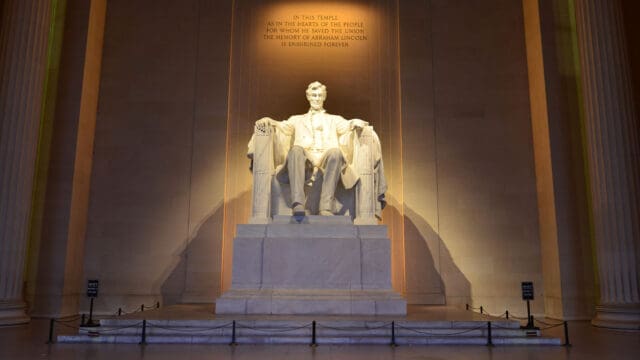
Not without its struggles, to be sure. America is still a toddler in some respects — or perhaps an adolescent. It has had its fair share of growing pains, even descending into civil war less than a century after its founding. He was not, of course, a “Founding Father,” but Abraham Lincoln’s role in guiding the nation through its most fraught years and out the other side of the hell that was the Civil War places him shoulder to shoulder with the founders, so it seems fitting to honor him as we honor them.
An Early Appreciation
I don’t recall a time when I didn’t have at least some understanding of the significance of his presidency. The fact that his tomb, home, and other Lincoln sites are located next door in Illinois made learning about him all the more appealing and accessible. While I confess I don’t recall all that much about it, I do recall a Girl Scout trip to Springfield, Illinois, in the spring of 1980 to visit the tomb and museum and the home where he and Mary Todd lived.
The Lincoln Lawyer
As an adult, my own legal career helped foster an abiding affinity for the self-taught trial lawyer. In the winter of 2014, I found myself following in his footsteps, so to speak, as I argued before the Illinois Court of Appeals in Mt. Vernon. Lincoln himself appeared there some 155 years earlier (before the Illinois Supreme Court, which was housed there at the time) and successfully argued a major tax case on behalf of the Illinois Central Railroad. My case involved a railroad as well — only as the opposition — and, like Lincoln, I won that one.
The Second Inaugural Address
But for all my familiarity with Lincoln, I hadn’t looked closely at his second inaugural address until just recently. While its closing paragraph begins with the familiar “With malice toward none with charity for all…,” the paragraphs preceding it were new to me. And as I read them now, in this moment in our history, they land differently than I suspect they would have even a decade ago.
Fellow countrymen: at this second appearing to take the oath of the presidential office there is less occasion for an extended address than there was at the first. Then a statement somewhat in detail of a course to be pursued seemed fitting and proper. Now, at the expiration of four years during which public declarations have been constantly called forth on every point and phase of the great contest which still absorbs the attention and engrosses the energies of the nation little that is new could be presented. The progress of our arms, upon which all else chiefly depends is as well known to the public as to myself and it is I trust reasonably satisfactory and encouraging to all. With high hope for the future no prediction in regard to it is ventured.
The address was delivered on March 4, 1865, just 41 days before Lincoln would be felled by an assassin’s bullet. Despite its brevity — roughly 700 words — the address somehow managed to wrap its arms around the tragedy of the previous four years while speaking to the future with hope.
Perhaps it’s my editor’s brain, but what jumped out to me there was this: “…is as well known to the public as to myself…” This was long before social media. News in 1865 traveled in analog fashion. And yet, Lincoln was confident that the American populace was fairly well up-to-speed on the status of the conflict. With far less access to information, they were nevertheless well-informed.
On the occasion corresponding to this four years ago all thoughts were anxiously directed to an impending civil war. All dreaded it ~ all sought to avert it. While the inaugural address was being delivered from this place devoted altogether to saving the Union without war insurgent agents were in the city seeking to destroy it without war ~ seeking to dissolve the Union and divide effects by negotiation. Both parties deprecated war but one of them would make war rather than let the nation survive, and the other would accept war rather than let it perish. And the war came.
While Lincoln remained hopeful for the future of the nation, he wasn’t interested in glossing over how it had been fractured, nor did he shy away from calling out those whose aim was a house divided. I read this: “Both parties deprecated war but one of them would make war rather than let the nation survive, and the other would accept war rather than let it perish,” and cannot help but see its overlay on the divisions we face today.
One eighth of the whole population were colored slaves not distributed generally over the union but localized in the southern part of it. These slaves constituted a peculiar and powerful interest. All knew that this interest was somehow the cause of the war. To strengthen perpetuate and extend this interest was the object for which the insurgents would rend the Union even by war while the government claimed no right to do more than to restrict the territorial enlargement of it. Neither party expected for the war the magnitude or the duration which it has already attained. Neither anticipated that the cause of the conflict might cease with or even before the conflict itself should cease. Each looked for an easier triumph and a result less fundamental and astounding. Both read the same Bible and pray to the same God and each invokes His aid against the other. It may seem strange that any men should dare to ask a just God’s assistance in wringing their bread from the sweat of other men’s faces but let us judge not that we be not judged. The prayers of both could not be answered ~ that of neither has been answered fully. The Almighty has His own purposes. ‘Woe unto the world because of offenses for it must needs be that offenses come but woe to that man by whom the offense cometh.’ If we shall suppose that American slavery is one of those offenses which in the providence of God must needs come but which having continued through His appointed time He now wills to remove and that He gives to both North and South this terrible war as the woe due to those by whom the offense came shall we discern therein any departure from those divine attributes which the believers in a living God always ascribe to Him. Fondly do we hope ~ fervently do we pray ~ that this mighty scourge of war may speedily pass away. Yet, if God wills that it continue until all the wealth piled by the bondsman’s two hundred and fifty years of unrequited toil shall be sunk and until every drop of blood drawn with the lash shall be paid by another drawn with the sword as was said three thousand years ago so still it must be said ‘the judgments of the Lord are true and righteous altogether.’
This, of course, was my “Whoa!” moment — or moments, I should say. There’s so much packed into this paragraph. First, that he marched straight on into the fire — there’s no sugarcoating here; no delicate dance around the gaping wound at the heart of it all. He names slavery and shames it, recognizing that it “constituted a peculiar and powerful interest” and was the cause of the war. Yes, I think it’s fair to say there were other issues, but Lincoln drills right down to the core here.
He acknowledges that neither side fully appreciated the magnitude of taking up arms against their fellow countrymen — the nightmare it would unleash. But isn’t that the way of history? And of the human condition? Even when we know, on some level, we’re headed down a dangerous path, we all too often forge ahead.
And then, the words that pierce the heart: “Both read the same Bible and pray to the same God and each invokes His aid against the other.” One sentence. Nineteen words. And yet, so much said. Now, we might look at this through 2026 eyes and think the reading the same Bible and praying to the same God premise no longer holds — at least not for many. But I would submit that even those who have rejected God and His Word remain subject to it. And believer or no, when you’re praying for the destruction of your fellow countrymen, something’s gone terribly awry.
Of course I can’t “hear” Lincoln’s voice, but something I’ve come to understand through my years of editing is that each writer has a distinct voice, and my inner ear “hears” more than just the words on the screen when I read them. When he speaks of slavery as an offense — a sin — while recognizing “this mighty scourge of war” as the wages of it, I hear both anguish and true faith in a sovereign God — an Almighty who loves us enough to call us to account.
And when Lincoln puts it like this, we’re hit with the enormity of it:
Yet, if God wills that it continue until all the wealth piled by the bondsman’s two hundred and fifty years of unrequited toil shall be sunk and until every drop of blood drawn with the lash shall be paid by another drawn with the sword as was said three thousand years ago so still it must be said ‘the judgments of the Lord are true and righteous altogether.’
I’m not into numerology, but his reference to 250 years of unrequited toil leaped out at me in light of the current moment. And through it all, Lincoln weaves the recognition of a righteous God.
With malice toward none with charity for all with firmness in the right as God gives us to see the right let us strive on to finish the work we are in to bind up the nation’s wounds, to care for him who shall have borne the battle and for his widow and his orphan ~ to do all which may achieve and cherish a just and lasting peace among ourselves and with all nations.
Moral Clarity and an Enduring Legacy
Though it may be less familiar than the Gettysburg Address or his first inaugural, his second inaugural may contain Lincoln’s most enduring lesson: A nation can tell the truth about its wounds without surrendering its hope, and it can seek justice without giving itself over to vengeance.
And that he’s able to simultaneously acknowledge our imperfect understanding while exhorting the nation to come together and bind its wounds, I believe, sums up why Abraham Lincoln can rightly be seen as a Founding Father and celebrated right alongside the others as we mark this monumental occasion.
Somehow, despite the deep divisions that threatened to tear the nation asunder — despite all the havoc wreaked and all the blood spilled — Lincoln managed to keep the nation from coming completely apart, thus ensuring that we survived to see America 250.
READ MORE REDSTATE ARTICLES BY SUSIE MOORE
Editor’s Note: Do you enjoy RedState’s conservative reporting that takes on the radical Left and woke media? Support our work so that we can continue to bring you the truth.
Join RedState VIP and use promo code FIGHT to receive 60% off your membership.